CARBON CREDITS
CARBON CREDITS
Before a Carbon Credit Unit can ever be issued, there must be an eligible Project capable of generating measurable environmental outcomes under an applicable carbon standard, methodology and regulatory framework.
MainStreet Renewables researches, structures and develops nature-based Carbon Projects, working through regional Project Proponents with landholders, customary landowners, communities, government authorities and specialist technical providers.
Our objective is to take an environmental opportunity and progressively develop the agreements, science, data, documentation and Project infrastructure required to move it toward independent validation, verification and, where all applicable requirements are successfully satisfied, Carbon Credit issuance.

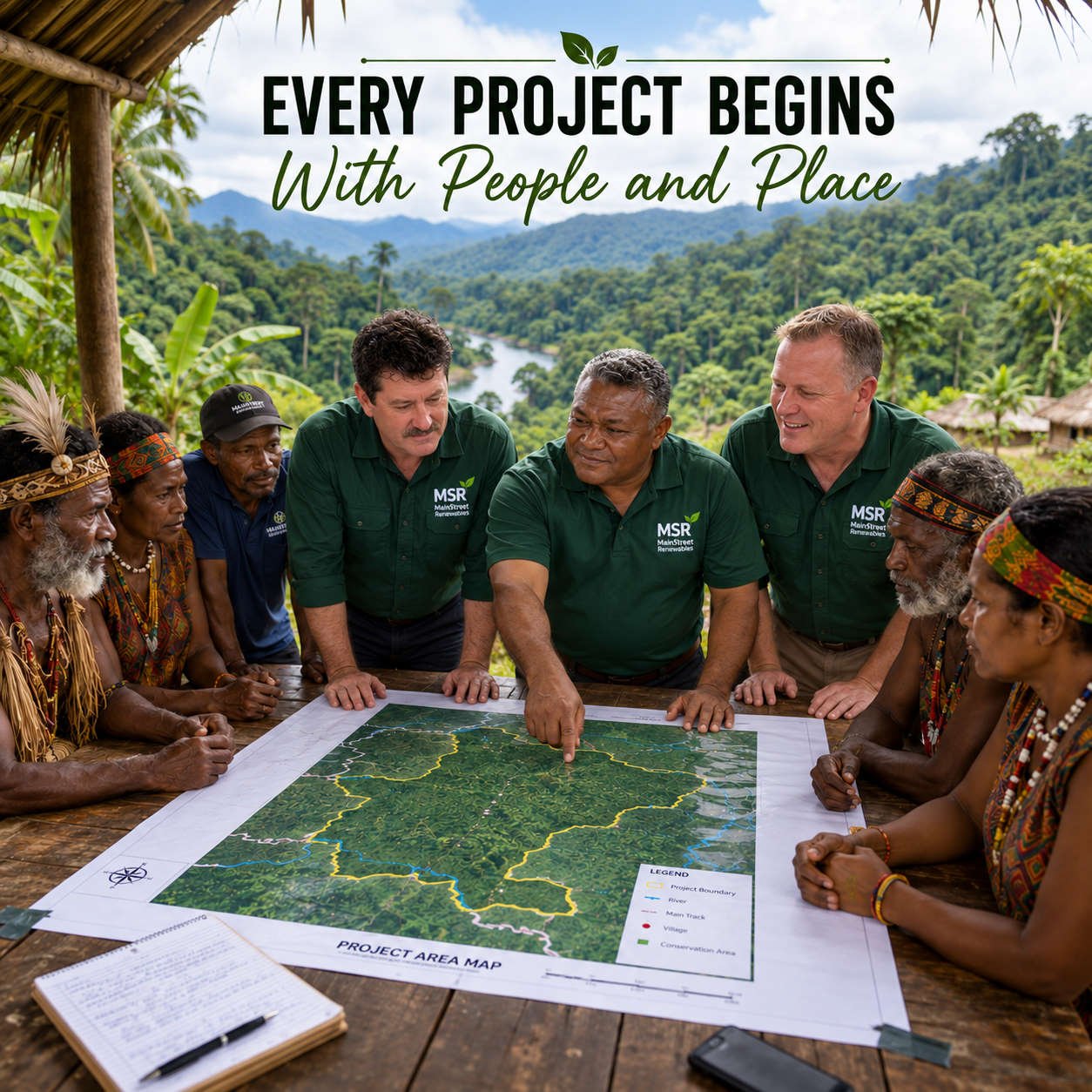
A CARBON PROJECT BEGINS WITH THE LAND
Nature-based Carbon Projects do not begin in a Registry.
They begin with land, forests, people and an identifiable environmental opportunity.
For Projects involving customary land, early Project development requires engagement with the people who hold rights and interests in that land. Project boundaries, land tenure, community participation, environmental objectives and the proposed Project activity must progressively be understood and documented.
Through regional Project Proponents, MainStreet Renewables works to bring together local participation and Project development with the technical, regulatory and commercial disciplines required by modern carbon markets.
This process is rarely straightforward. Customary land is often held under overlapping or undocumented arrangements, shaped by kinship, custom and long-standing local practice rather than formal title. Understanding who holds rights and interests in the land — and how those rights are recognised, shared or contested — is foundational work that must be done before any Project design can begin.
Regional Project Proponents play a central role in this process. Operating on the ground and within the relevant customary, legal and cultural context, they are positioned to engage directly with landholders and communities, build the trust required for genuine participation, and progressively translate local knowledge into the documented record a Carbon Project requires.
FOUNDATIONS OF A CARBON PROJECT

LAND & COMMUNITY
Rights, Participation & Local Knowledge
A credible nature-based Project requires a clear understanding of the land, the people connected to it and the environmental activity being proposed.

SCIENCE & METHODOLOGY
Measurement, Evidence & Project Design
The Project must be capable of being measured and documented using the applicable methodology, supported by appropriate field data, mapping, monitoring and technical analysis.

GOVERNANCE & ASSURANCE
Rules, Documentation & Independent Review
Project development must operate within the applicable legal, regulatory and carbon-program framework and progress through the required independent technical assessment processes.
FROM OPPORTUNITY TO CARBON PROJECT
Not every forest or environmental activity automatically qualifies as a Carbon Project.
A potential Project must first be researched to understand the land, environmental conditions, Project activity, applicable methodology, regulatory requirements, technical feasibility and potential for measurable environmental outcomes.
If the opportunity is suitable for further development, the Project can progressively move through landholder engagement, community awareness, Project boundary definition, methodology selection, field assessment, baseline development, Project design, documentation and regulatory or technical review.
None of this can be shortcut. A Project boundary drawn without landholder engagement, or a consent obtained without genuine community understanding, undermines the integrity of everything that follows — the methodology applied, the baseline established, and ultimately the credibility of any Carbon Credit Unit that may be issued.
It is this early, careful work — conducted at the intersection of land, people and law — that MainStreet Renewables regards as the true starting point of a nature-based Carbon Project. The Registry entry, when it eventually occurs, is the final record of a process that began, long before, on the land itself.

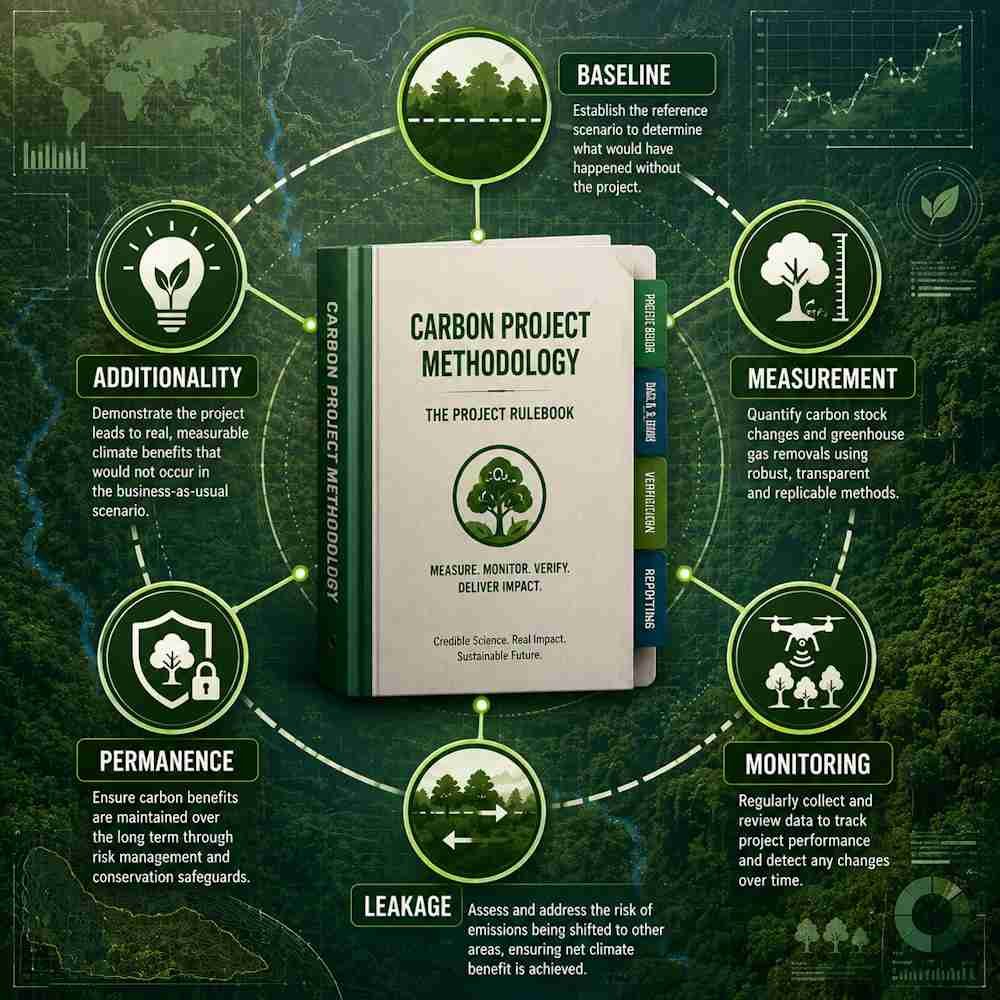
THE METHODOLOGY DEFINES THE RULES
A carbon methodology provides the technical framework used to determine how an eligible Project activity is assessed, measured, monitored and reported.
The appropriate methodology depends upon the Project type, environmental activity, applicable carbon standard and regulatory framework.
A methodology may establish requirements relating to the Project boundary, baseline conditions, additionality, sampling, measurement, monitoring, leakage, permanence, uncertainty and the calculation of eligible emission reductions or removals. No two Projects apply a methodology in exactly the same way.
For MainStreet Renewables, selecting and applying the appropriate methodology — and correctly interpreting its requirements — is therefore a fundamental part of Project development.
PROJECT TYPES
Nature-based carbon markets can encompass different Project activities depending upon the applicable standard, methodology, jurisdiction and environmental circumstances. The examples below describe Project categories only; eligibility depends upon the requirements applicable to each individual Project.

FOREST CONSERVATION
Protecting qualifying forest landscapes where an applicable methodology and regulatory framework supports the proposed Project activity.

REFORESTATION
Restoring tree cover and forest ecosystems on qualifying land through appropriately designed reforestation activities.

AFFORESTATION
Establishing qualifying new forest cover on land that satisfies the applicable methodology and Project requirements.

AGROFORESTRY & PLANTATION
Integrating trees and productive land uses where eligible Project activities can produce measurable environmental outcomes under an applicable methodology.
THE PEOPLE BEHIND THE CARBON
PROTECTING FORESTS. SUPPORTING COMMUNITIES. BUILDING LONG-TERM VALUE.
For community-based nature Projects, forests cannot be separated from the people who live with, use and protect them.
Project development therefore requires more than technical carbon calculations.
It requires meaningful engagement, understanding of land and resource rights, community awareness, appropriate agreements, benefit-sharing arrangements and long-term participation.
MainStreet Renewables' Project-development approach seeks to connect environmental protection with economic opportunity so that the communities associated with qualifying Projects can participate in the benefits generated through responsible Project development.

WHAT MAKES A CREDIBLE CARBON PROJECT?
A Carbon Project should be capable of demonstrating more than a large area of forest. Its credibility depends upon the quality of the Project design and the evidence supporting the environmental outcomes being claimed.
CLEAR RIGHTS
Land and carbon rights appropriately established.
DEFINED BOUNDARY
The Project area identified and mapped.
APPLICABLE METHODOLOGY
A suitable methodology and carbon-program framework.
MEASURABLE OUTCOMES
Environmental outcomes capable of measurement and monitoring
INDEPENDENT ASSURANCE
Validation and verification under the applicable requirements.
TRACEABILITY
Eligible issued units ultimately recorded and identifiable within the applicable Registry.
FROM CARBON PROJECT TO CARBON CREDIT
Project development creates the foundation.
Measurement and monitoring create the evidence.
Validation and verification provide independent technical assessment.
Where the Project successfully satisfies the applicable methodology, regulatory and carbon-program requirements, eligible environmental outcomes may progress toward Carbon Credit issuance.
At that point, the story moves from Carbon Project development to the Carbon Credit Unit.
Where applicable to the relevant commercial arrangement, an eligible issued CCU may subsequently be reconciled against a pre-issuance Carbon Credit Future reservation. A CCF is not itself an already issued Carbon Credit Unit.

FREQUENTLY ASKED QUESTIONS
WHAT IS A CARBON PROJECT?
A Carbon Project is a defined activity designed to generate measurable emission reductions, avoided emissions or removals under an applicable carbon standard, methodology and regulatory framework.
DOES OWNING FOREST AUTOMATICALLY CREATE CARBON CREDITS?
No. Forest ownership or land rights alone do not automatically create issued Carbon Credit Units. An eligible Project must satisfy the applicable legal, methodological, technical, assurance and issuance requirements.
WHAT ARE CARBON RIGHTS?
Carbon rights concern the legal rights and interests associated with carbon-related environmental benefits. Their nature and treatment depend upon the jurisdiction and the applicable Project framework.
WHY ARE LANDHOLDER AGREEMENTS IMPORTANT?
They help establish the rights, participation, responsibilities and commercial arrangements necessary for Project development, particularly where customary or community land is involved.
WHAT IS A PROJECT BOUNDARY?
The Project boundary defines the geographic area and, where relevant, the sources, sinks or activities included within the Project for measurement, monitoring and accounting purposes.
WHAT IS A BASELINE?
The baseline is the reference scenario against which eligible Project outcomes are assessed under the applicable methodology.
WHAT IS ADDITIONALITY?
Additionality addresses whether the claimed environmental outcome is additional to what would reasonably have occurred without the Project, according to the applicable methodology or program rules.
WHAT IS PERMANENCE?
Permanence concerns the durability of the environmental outcome and the management of reversal risk over the period required by the applicable program.
WHAT IS LEAKAGE?
Leakage concerns increases in emissions or displacement of activities outside the Project boundary that may occur because of the Project and that must be addressed where required.
WHY IS COMMUNITY PARTICIPATION IMPORTANT?
For community-based nature Projects, local participation is fundamental to understanding rights, land use, Project implementation, benefit sharing and long-term Project durability.
WHAT IS A CARBON METHODOLOGY?
A methodology is the technical rulebook that establishes how an eligible Project activity is defined, measured, monitored, calculated and reported.
WHEN CAN A PROJECT GENERATE CARBON CREDIT UNITS?
Only where the applicable Project, methodology, regulatory, validation, verification and issuance requirements are successfully satisfied can eligible outcomes progress toward issuance as Carbon Credit Units.
EVERY CARBON CREDIT BEGINS WITH A PROJECT
Land. People. Science. Integrity.
MainStreet Renewables is focused on developing the foundations upon which credible Carbon Credit Units can ultimately be created.
From landholder and community engagement through Project design, measurement, monitoring, regulatory processes and independent technical assessment, each stage contributes to the integrity of the environmental asset that may eventually be issued.
The Project and the people come first. The Carbon Credit Unit is the outcome of the process.
